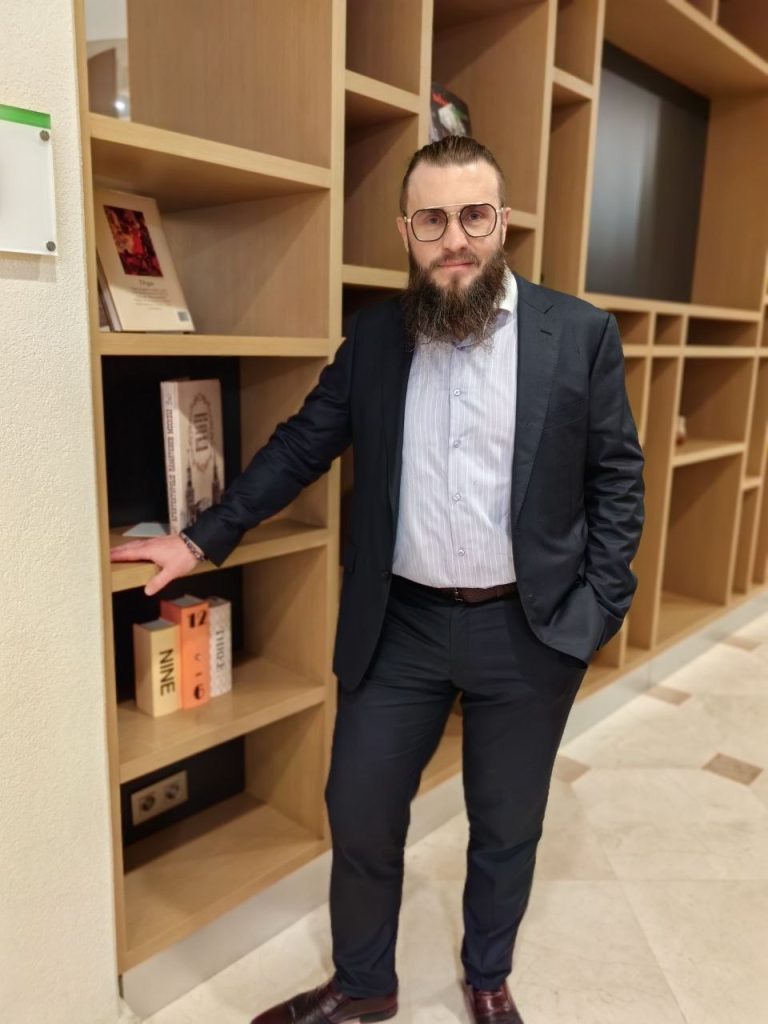
Alexander A. Fischuk
Founder and scientific director of the ANO Scientific Research Institute of System Synthesis (Moscow); advocate.
Alexander A. Fischuk
Methodological position
Formally verifiable solutions take priority over behavioural ones, local deployment over the cloud, and the discipline of provenance over the optimization of metrics.
The point is not to set methods against each other but to separate their areas of applicability: the load-bearing loops of critical systems need guarantees derived from a formal axiomatics, not from empirical distributions.
In this logic the institute’s programme is not an alternative to the dominant AI paradigm but its necessary complement for classes of problems where the cost of an error exceeds the cost of detecting it.
Education
- 1997–2002. Volgograd State Technical University: engineer-economist.
- 2003–2006. Institute of Professional Accountants of Russia: professional accountant (IFRS).
- 2012–2013. North-West Institute of Management, Russian Presidential Academy of National Economy and Public Administration (RANEPA): crisis management; insolvency practitioner (arbitration manager).
- 2012–2015. Financial University under the Government of the Russian Federation: law.
Professional career
- 2026–present. Founder and scientific director of the ANO Scientific Research Institute of System Synthesis.
- 2016–present. Practice as an advocate: protection of capital, support of insolvency proceedings, tax security.
- 2008–2016. Head of consulting firms: business support, commercial litigation, support during tax audits, reorganization and liquidation of legal entities, insolvency proceedings.
- 2006–2008. WJ Grain: chief accountant, chief financial officer.
- 2005–2006. LUKOIL-Nizhnevolzhskneft: engineer, internal control department.
- 2003–2005. FiKON: external auditor.
- 2002–2003. Rosmashkom: engineer-economist.
The thread of a professional career
More than twenty years of work in regulated environments with formally defined normative frameworks: internal audit at a major oil company, chief financial officer of an international grain trader, crisis management, tax practice, insolvency support, protection of capital as an advocate. What runs through this path is work with systems in which a decision is judged correct not by its result but by its compliance with a standard of proof, and in which an error costs far more than the gain from making it.
The Institute of System Synthesis was founded as a natural continuation of this line in the field of autonomous computing systems. The architectural principle of Compliance by Design, building conformity with institutional requirements into the axiomatics of a system before it executes, coincides in method with the principle of audit and legal work: the norm is checked when an operation is designed, not when its consequences arrive. This coincidence is not an analogy. It is the basis for carrying the discipline of formal checking over from legal and financial practice into the architecture of autonomous agents.
The programme’s production reference implementation, the multi-agent system MITR, has been running since 24 April 2026 and serves fiduciary tasks inside a closed perimeter. This operational role gives methodological reliability rather than a marketing demonstration: the programme’s architectural claims are tested every day by the developer’s own use of the system in professional practice.
How professional experience relates to the subject of the programme
The institute builds an architecture in which an autonomous executor works under conditions similar to those of a regulated profession: a fixed normative environment, mandatory logging of actions, separation of functions by the principle of irreversibility, and an architecture that makes key restrictions impossible to bypass.
In substance this task coincides with that of internal audit, tax support and legal defence in regulated industries. The difference is that the classical disciplines apply formal checking to human decisions after the fact, while the institute’s programme moves it into the architecture of an autonomous system and applies it before execution.
Most of the cases that make up legal and audit practice arise not from an actor’s bad intent but from a mismatch between the action taken and the normative environment the actor belongs to. If every professional decision were checked against the applicable normative framework before it was made, a considerable share of the later defensive, restorative and rescue procedures (tax disputes, insolvency proceedings, corporate conflicts) would have no grounds to arise.
The fundamental obstacle to such a regime for a human executor is the cognitive cost of constant normative checking: for most professional decisions the volume of applicable norms exceeds the practical limit of attention and working memory.
This limitation gives rise to the class of problems served by the classical retrospective disciplines. An autonomous computing system has no such limitation: checking an action against the axiomatics takes less than a millisecond and can run continuously at no cognitive cost.
In this logic an autonomous agent with formal verification of its decisions does not replace the classical retrospective disciplines. It supplies the part of their function that a human executor could never perform continuously.
A further mechanism seen in this practice is an executor repeating successful decisions from past experience after the normative environment has already changed.
By its economic nature professional thinking works through pattern matching: accumulated cases become templates applied to new situations. This mode is effective in a stable environment and fails systematically under accelerated regulatory drift: the actor builds a decision on a picture of a normative field that no longer exists.
Structurally this failure coincides with the hallucination of a large language model: a conclusion plausible in form that diverges from current reality, because generation relies on a distribution detached from the environment where it is applied. The only difference is the source of the distribution: professional experience for a person, the training corpus for a language model. The architectural answer is the same in both cases: an external check of the action against the current normative axiomatics before it is executed.
Experience with IFRS financial reporting, internal audit at a major corporation, crisis management and legal practice provides the grounds for two research positions of the programme.
The first is that formal verification of an autonomous agent’s actions is not scientific exotica but an infrastructural norm, missing from the current AI paradigm for constructive rather than technical reasons.
The second is that the regulatory framework (Federal Law 187-FZ, FSTEC Order 117, GOST R 57580 and similar) does not prevent the deployment of autonomous systems but sets the specification by which they should be built from the start.
Publications

Alexander Fischuk, scientific director of the institute
For owners and chief executives: who actually controls an AI agent and who answers when it makes a mistake; a map of 2027–2035 along five axes, three scenarios with benchmarks, and a strategy in which the human signs the rule and the gate checks every action. Every claim is labelled: measured, being built, plan, forecast.
About the book and chapter formulas → · Architectural memorandum (PDF, 41 pages, in Russian) · E-book on LitRes (in Russian) · Independent verification protocol
Public channels
- Telegram channel “System Synthesis”: artificial intelligence at the intersection of technical and legal reality (in Russian). t.me/agiandhuman
- Telegram channel “Kautilya”: the cybernetics of Advaita, an operating system of consciousness (in Russian). t.me/afishchuk
- Author’s domain: fishchuk.su.
Professional profiles (in Russian): Pravorub · Zakon.ru · Regforum · GitHub · Klerk.ru
Contact the institute: info@isslab.ru. The contact form at isslab.ru/contacts/ is in Russian. About the institute: legal details, subject of work, cooperation.